Rapid Skills Supply and Demand Assessment in Four Districts of Ghana - UNICEF
CLIENT:
UNICEF Ghana
Project Overview
UNICEF Ghana commissioned EyeCity Africa, working with LIFE-MAC Africa, to assess the supply of and demand for technical and vocational education and training (TVET) in four rural, cocoa-growing districts: Bibiani-Anhwiaso-Bekwai (Western North), Ayensuano (Eastern), Asunafo North (Ahafo) and Assin South (Central).
The study examined skills mismatches, graduate outcomes and inclusion, and the relationship between skills pathways and hazardous child work, to give government and partners evidence they can act on.
Project Structure
Research Design and Data Collection
We applied the ILO Skills for Trade and Economic Diversification (STED) framework and a graduate tracer approach. Six survey instruments, run on an offline-capable platform suited to low-connectivity rural areas, reached TVET institution heads, Master Craft Persons running informal apprenticeships, employers, TVET graduates 12 to 36 months after training, parents and community members, and regional and national institutions. In total, 243 survey responses were complemented by 122 key informant interviews and 12 focus group discussions with in-school learners, out-of-school youth, and parents and community members. Preliminary findings were reviewed with stakeholders at a validation workshop.
Key Findings
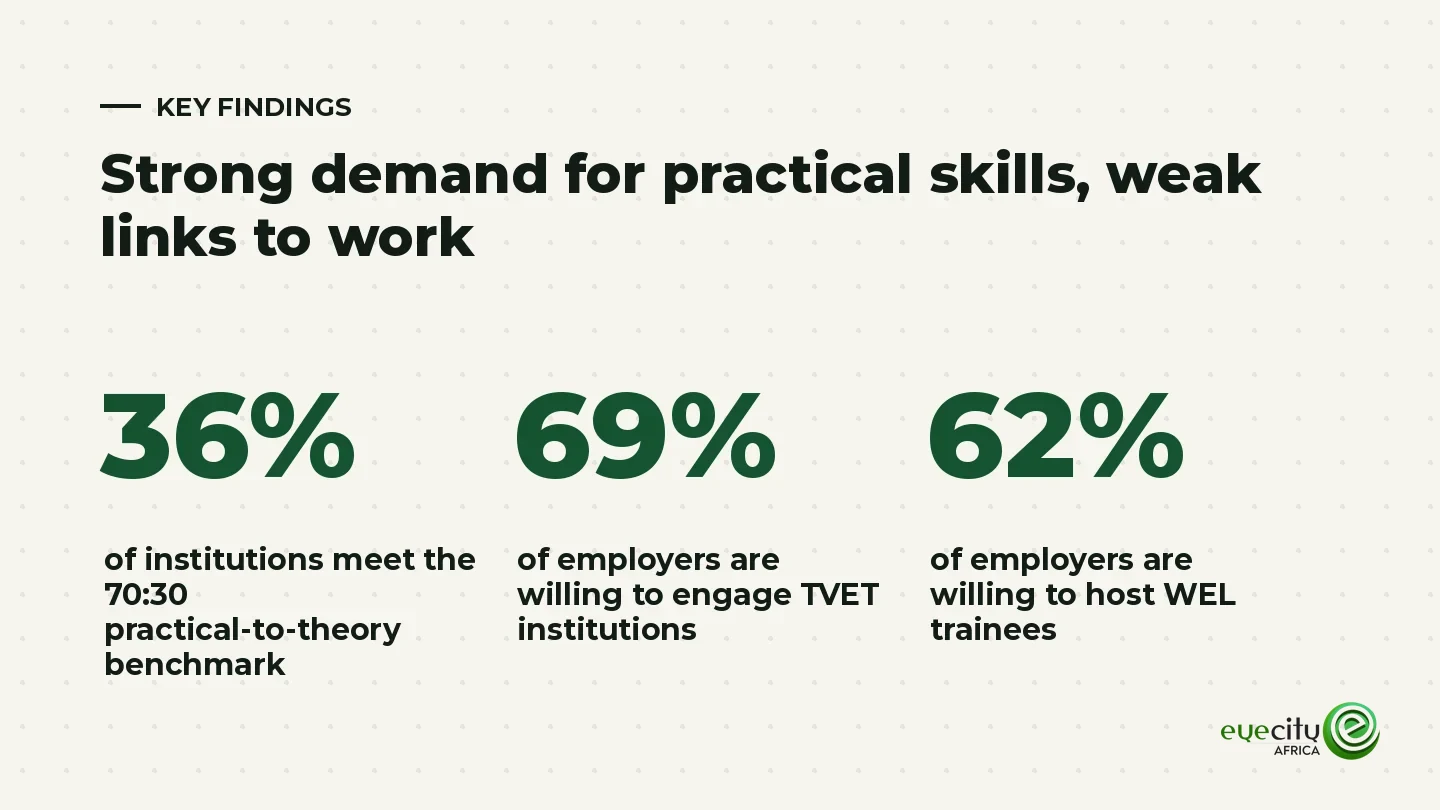
TVET is valued, but delivery is uneven: only 36% of surveyed institutions meet the 70:30 practical-to-theory benchmark, held back by equipment, consumables, workshops and instructor capacity.
Workplace exposure is critical: Workplace Experience Learning (WEL) is one of the strongest bridges from training to employment, especially where placements are supervised and linked to employers.
Outcomes depend on place: graduate outcomes differed more by district than by sex, trade or training pathway.
Informal apprenticeships reach vulnerable youth but offer weaker protections, with limited age controls, safeguarding and certification.
Skills access alone does not prevent hazardous child work: household financial pressure and weak post-training livelihoods push young people towards immediate-income work such as cocoa, galamsey and street trading.
Demand is strong but links are weak: employers need welding, fabrication, plumbing, electrical and mechanical skills, and 69% are willing to engage TVET institutions and 62% to host WEL trainees, yet these relationships are rarely formalised.
Recommendations
Fund equipment, consumables, instructors and WEL supervision on time, and modernise practical training.
Align TVET provision with each district's economy, from mining services and agro-processing to solar, automation and high-demand trades.
Formalise employer partnerships and WEL through written agreements, supervision and safeguarding.
Strengthen informal apprenticeships through Master Craft Person registration, Recognition of Prior Learning, certification and minimum-age standards.
Reduce the costs that keep vulnerable youth out of training, and actively recruit girls and persons with disabilities into technical trades.
Link TVET with child-protection and second-chance systems, and strengthen district-level data and coordination.
Impact
Produced district-level evidence on skills supply, labour-market demand and child-labour risk in four cocoa-growing districts.
Delivered multi-level recommendations for UNICEF, government and TVET partners at policy, institutional and programme level.
Brought institutions, employers, Master Craft Persons, young people and communities into a validated picture of what works.