Innovation and Entrepreneurship Landscape within Higher Education Institutions in Nigeria
CLIENT:
National Universities Commission (NUC)
Project Overview
EyeCity Africa and the National Universities Commission (NUC) jointly researched and published Innovation and Entrepreneurship Landscape within Higher Education Institutions (HEIs) in Nigeria (2026), a national assessment of how universities, polytechnics and colleges of education turn entrepreneurship education, research and innovation infrastructure into student enterprises, commercialised research and jobs.
Preliminary findings were first presented at the Stakeholder Roundtable on Rethinking Entrepreneurship and Innovation in Higher Education, which EyeCity Africa co-hosted with the NUC in Abuja in November 2025. The final report was formally released at a virtual launch with stakeholders from higher education, government, development agencies and the private sector.
Project Structure
Research Design
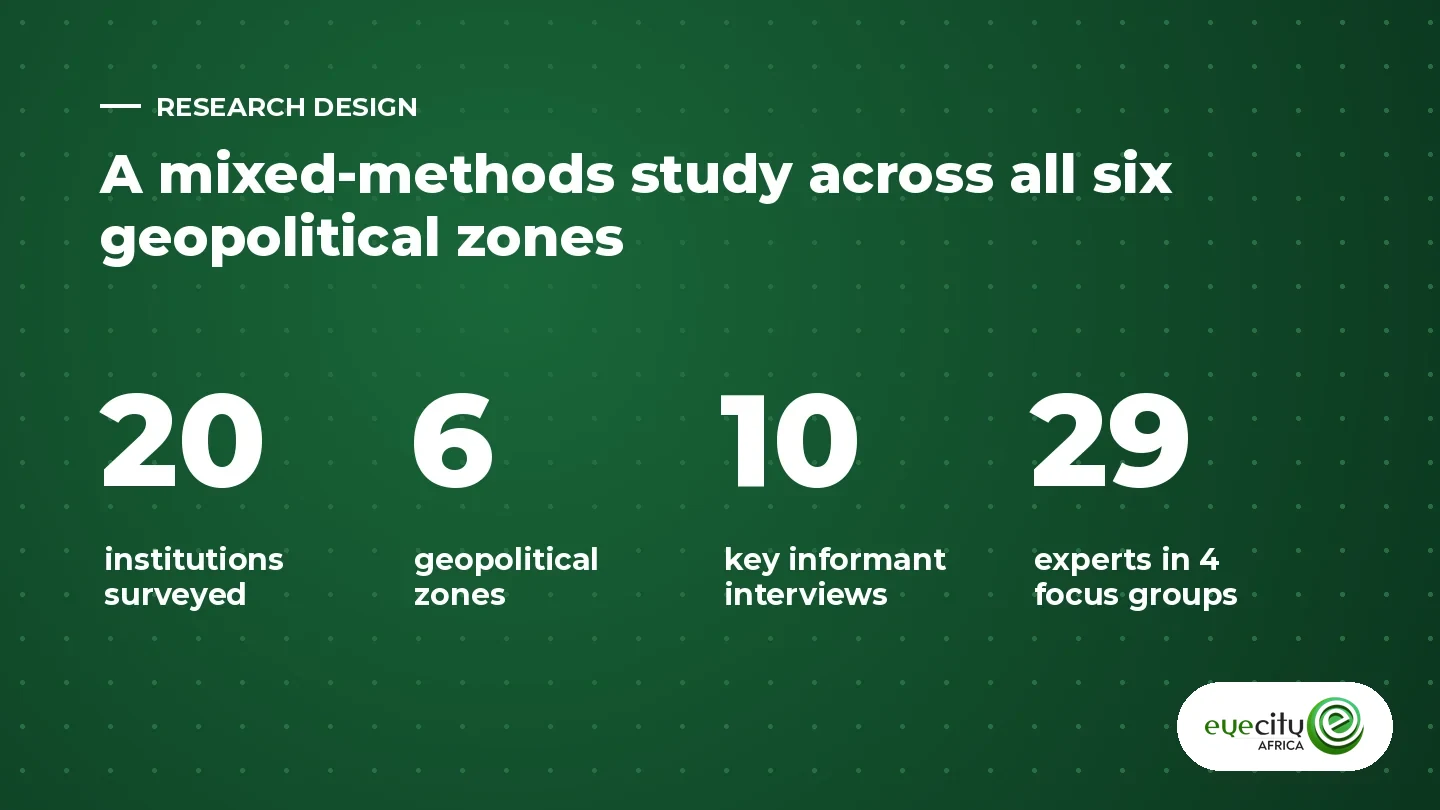
The study used a mixed-methods design: a 37-question survey of 20 institutions selected by stratified random sampling across all six geopolitical zones (75% universities, 20% polytechnics and 5% colleges of education; 80% public and 20% private), 10 key informant interviews, and four focus group discussions with 29 industry, policy and HEI experts.
Key Findings
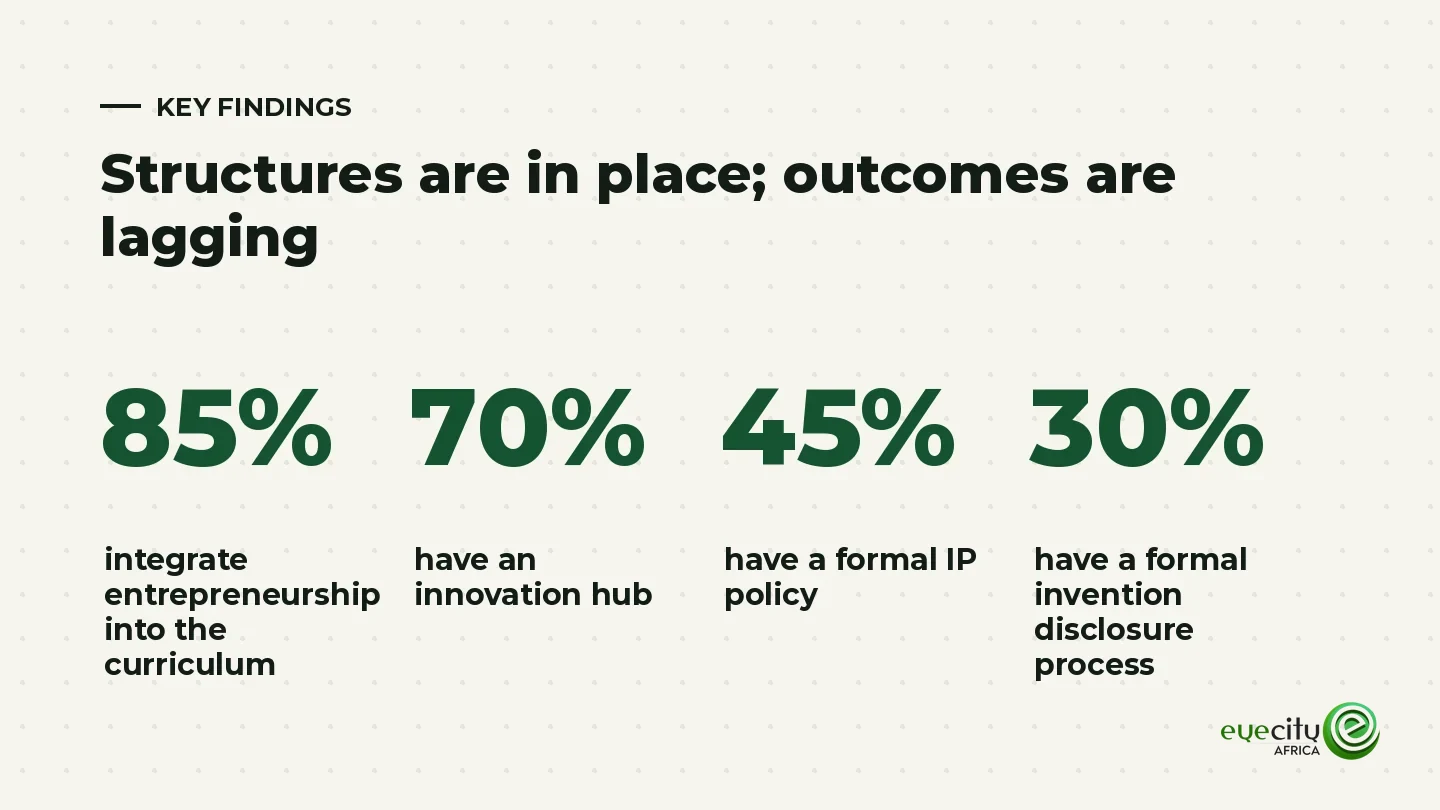
Near-universal compliance, uneven quality: 85% of institutions have integrated entrepreneurship into the curriculum, but programmes range from basic vocational skills to innovation-led venture development.
Infrastructure without pipelines: 70% have an innovation hub, yet many hubs operate as episodic event spaces rather than continuous venture pipelines.
Few ventures come through: 55% of institutions have incubated fewer than five student-led enterprises, and 45% report innovation activity that does not progress beyond the concept stage.
Weak intellectual property systems: only 45% have a formal IP policy and 30% a formal invention disclosure process.
Fragile partnerships and funding: industry links rely on individual faculty contacts, only 45% have a formal policy for external collaboration, and funding is mostly short-term and focused on infrastructure.
Recommendations
The report sets out an HEI Innovation Model, co-conceptualised by the NUC and EyeCity Africa, and recommendations for four groups:
Higher education institutions: set up Industry Partnership and Engagement Offices, engage at least ten strategic industry partners each year, and move to experiential, problem-based learning.
Industry: act as co-creation partners in applied research, centres of excellence, mentorship and the market adoption of academic innovations.
Government ministries, departments and agencies: shift regulation and funding from inputs to outcomes such as enterprise creation, patent commercialisation and graduate employability.
Development partners: provide catalytic and blended finance, technical assistance and global market linkages.
Report Launch
At the virtual launch, a panel drew on the findings. Etom Ofem (British Council) spoke on moving from employability-only models to opportunity-driven innovation and formal industry partnership offices. Dr Mofope Israel-Adegboye (World Bank Group) spoke on the gap between infrastructure funding and pipeline funding, and on blended finance to de-risk academic ventures. Prof. Lanre Amodu (Covenant University) shared how Covenant University teaches entrepreneurship at every level of study and acts as the first customer for student ventures.
Impact
Produced a national evidence base on innovation and entrepreneurship in Nigerian HEIs, co-published with the federal regulator for universities.
Gave institutions, industry, government and development partners a shared framework, the HEI Innovation Model, and practical recommendations.
Informs the work of the Innovation Working Group, which brings together the NUC, EyeCity Africa, the British Council, HEIs, enterprise support organisations, IP specialists and investors to coordinate reform.